


My Research
My research explores modern workplace changes. Here is an overview of my current work on three interconnected streams: AI Integration and the Future of Work, Flexible Work Arrangements, and Modern Workplace Designs.
AI Integration and the Future of Work
Artificial intelligence is not merely another technological advancement—it represents a paradigm shift in how work is experienced and managed. My research examines the psychological and organizational implications of this shift, focusing on technostress in the age of AI.
Traditional models of technostress were developed in response to earlier generations of technology, yet they fail to capture the unique intensity and complexity of stressors created by AI systems. My dissertation theorizes a new framework of AI-driven technostress, offering a conceptual model that distinguishes these emerging stressors from traditional technology-induced strain.
At the same time, I explore how trust and felt trust serve as key buffering mechanisms. Together, these dynamics shape how individuals adapt to AI integration in organizations.
This research has received the Best Paper Award (Eastern Academy of Management, 2025) and forms the basis of a revise-and-resubmit at the Journal of Trust Research. In addition, I am developing a conceptual paper on technostress in the age of AI, expanding this framework to guide future empirical and theoretical inquiry.
Ultimately, this stream of work seeks to redefine how we understand human experiences with intelligent systems—moving from fear and resistance toward resilience, trust, and meaningful collaboration between humans and AI.
Flexible Work Arrangements
My second line of research focuses on flexible work arrangements—including remote, hybrid, and digitally mediated work—and how they transform the social and psychological fabric of organizations. As flexibility becomes a defining feature of modern work, I examine both its benefits and hidden challenges, particularly in relation to employee connection, well-being, and adaptability.
One stream of this research investigates remote work and community embeddedness. Drawing on social exchange and identity theories, I explore how remote work can simultaneously foster loneliness and a deeper sense of embeddedness within one’s community. This nuanced perspective moves beyond the simplistic “remote work is isolating” narrative to uncover how employees construct belonging in digitally mediated contexts. A manuscript from this project is currently under review at the Journal of Organizational Behavior.
A second stream addresses telepressure—the compulsion to respond quickly to work-related communications. In our published paper in the Journal of Managerial Psychology, we examine how telepressure shapes employee well-being, performance, and work-life boundaries, offering actionable insights for designing healthier digital communication norms.
Together, these studies illustrate how flexibility in work arrangements can enhance autonomy and inclusivity, yet also introduce new psychological strains. My goal is to inform evidence-based strategies that enable organizations to balance flexibility with human connection, productivity, and mental health.
Modern Workplace Design and Human Experience
My third line of research examines how physical and sensory elements of workplace design—from biophilia and color to spatial layout and materiality—shape employee perceptions, creativity, and well-being. As organizations increasingly recognize space as a strategic asset, my work seeks to understand how design influences human experience, motivation, and performance.
A central focus of this stream is biophilia in workplace design. In our article published in Human Resource Management (FT50), we demonstrate that job applicants are often willing to “trade green for green”—that is, they are prepared to accept lower compensation in exchange for working in more nature-integrated, biophilic environments. This finding highlights how sustainability and human-centered design can create competitive advantages for organizations seeking to attract and retain talent.
Beyond biophilia, my ongoing review project on workplace aesthetics and creativity examines how elements such as color, temperature, spatial arrangements, and artifacts influence both individual and team creativity. This integrative effort bridges organizational behavior, environmental psychology, and design research, offering a comprehensive framework for understanding how physical spaces can foster innovation.
Together, these studies underscore a broader research vision: to help organizations design modern workplaces that are not only efficient and beautiful but also psychologically supportive and creativity-enhancing—spaces where people and ideas can truly flourish.
Methodological Expertise
I am proficient in quantitative research methods, utilizing statistical packages such as R, STATA, SPSS, and Minitab. My methodological expertise spans a wide range of analytical techniques, including mediation and moderation analysis, structural equation modeling (SEM), meta analysis, scale development, and multivariate statistics, ensuring that my research findings are both rigorous and valid.
In addition to traditional survey-based approaches, I have extensive experience with experimental designs, particularly vignette-based and scenario-driven experiments that enable the manipulation of psychological and contextual variables in organizational settings. These approaches allow me to test complex behavioral mechanisms related to AI integration, technostress, and workplace design under controlled yet realistic conditions.
More recently, I have begun to integrate qualitative methods—such as semi-structured interviews and thematic analysis—into my research. This mixed-methods approach allows me to capture deeper contextual insights, giving voice to participants’ lived experiences and complementing my quantitative findings.
Publications & Research Projects
Below you will find an overview of my current and published research and my conference presentations.
PEER-REVIEWED JOURNAL PUBLICATIONS
Merriman, K., Kostanski, S., Ebrahimi, N., Montag-Smit, T. (2025). “The Signaling Effect of Biophilic Job Posts: Do Applicants Trade Green for Green?” Human Resource Management, https://doi.org/10.1002/hrm.22285. [Link]
Smit, B., Ebrahimi, N., Montag-Smit, T., Boyar, SL., Maertz, C. (2025). “The Hidden Pitfalls of Flexibility: How Work Flexibility Can Promote Strain and Work-Family Conflict Through Telepressure”. Journal of Managerial Psychology, https://doi.org/10.1108/JMP-01-2024-0027. [Link]
Ebrahimi, N.*, and Yurtkoru, E. S. (2017). “The relationship between affective commitment and unethical pro-organizational behavior: The role of moral disengagement”. Research Journal of Business and Management, 4(3), 287-295. [Link]
* Master’s Thesis
MANUSCRIPTS UNDER REVIEW
Ebrahimi, N., Montag-Smit, T., Greenway D., Kostanski, S. (Under Review). Remote work’s dual nature: Inducing workplace loneliness while facilitating community embeddedness. Journal of Organizational Behavior.
Ebrahimi, N.*, Montag-Smit, T. (R&R Stage). Employee felt trust: A critical review and future directions. Journal of Trust Research.
* Ph.D. Dissertation, Essay 1
MANUSCRIPTS IN PREPARATION
Ebrahimi, N. [Topic: Reconceptualizing Technostress for the Age of AI: Uncertainty, Appraisal, and Employee Adaptation]. Stage: Writing. Target: Academy of Management Review.
Kostanski, S., Montag-Smit, T., Ebrahimi, N., [Topic: Theory of interaction of social and individual processes for individual creativity]. Stage: Writing. Target: Academy of Management Review.
Montag-Smit, T., Keith, M., Ebrahimi, N., Smit, B., Sirkwoo, J. [Topic: Motivation and creativity: A meta-analysis]. Stage: Data entry. Target: Journal of Applied Psychology.
Ebrahimi, N., Montag-Smit, T., Kronrod, A., [Topic: The effect of servant leadership on languishers’ social functioning and organizational identification]. Stage: Writing. Target: Leadership Quarterly.
Ebrahimi, N., Kimberly, M., Montag-Smit, T. [Topic: Servant leadership: A systematic review and future research direction]. Stage: Writing. Target: TBD.
BOOK CHAPTER IN PRESS
Feldman, E., Kostanski, S., Montag-Smit, T., Ebrahimi, N., (In Press). The role of workplace relationships as potential antidotes to loneliness. In Hughes, E., Krueger, J., Roberts, T., Seemann, A. (Eds). An Interdisciplinary Investigation of Loneliness: Bloomsbury Press.
PEER-REVIEWED PRESENTATIONS
Smit, B., Ebrahimi, N., Montag-Smit, T., Boyar, SL., Maertz, C. (2025). The Hidden Pitfalls of Flexibility: How Work Flexibility Can Promote Strain and Work-Family Conflict Through Telepressure. Paper presented at the Academy of Management Conference, July 25-29, 2025, Copenhagen, Denmark.
Ebrahimi, N., Montag-Smit, T., Greenway D., Kostanski, S. (2025). Remote but Not Alone: Leveraging Community Embeddedness to Boost Well-Being. Paper presented at the Academy of Management Conference, July 25-29, 2025, Copenhagen, Denmark.
Pirson, M., Ebrahimi, N., et al. (2025). Reality Proves Possibility- Humanistic Management as Enabler of Dignity and Flourishing for All. PDW workshop presented at the Academy of Management Conference, July 25-29, 2025, Copenhagen, Denmark.
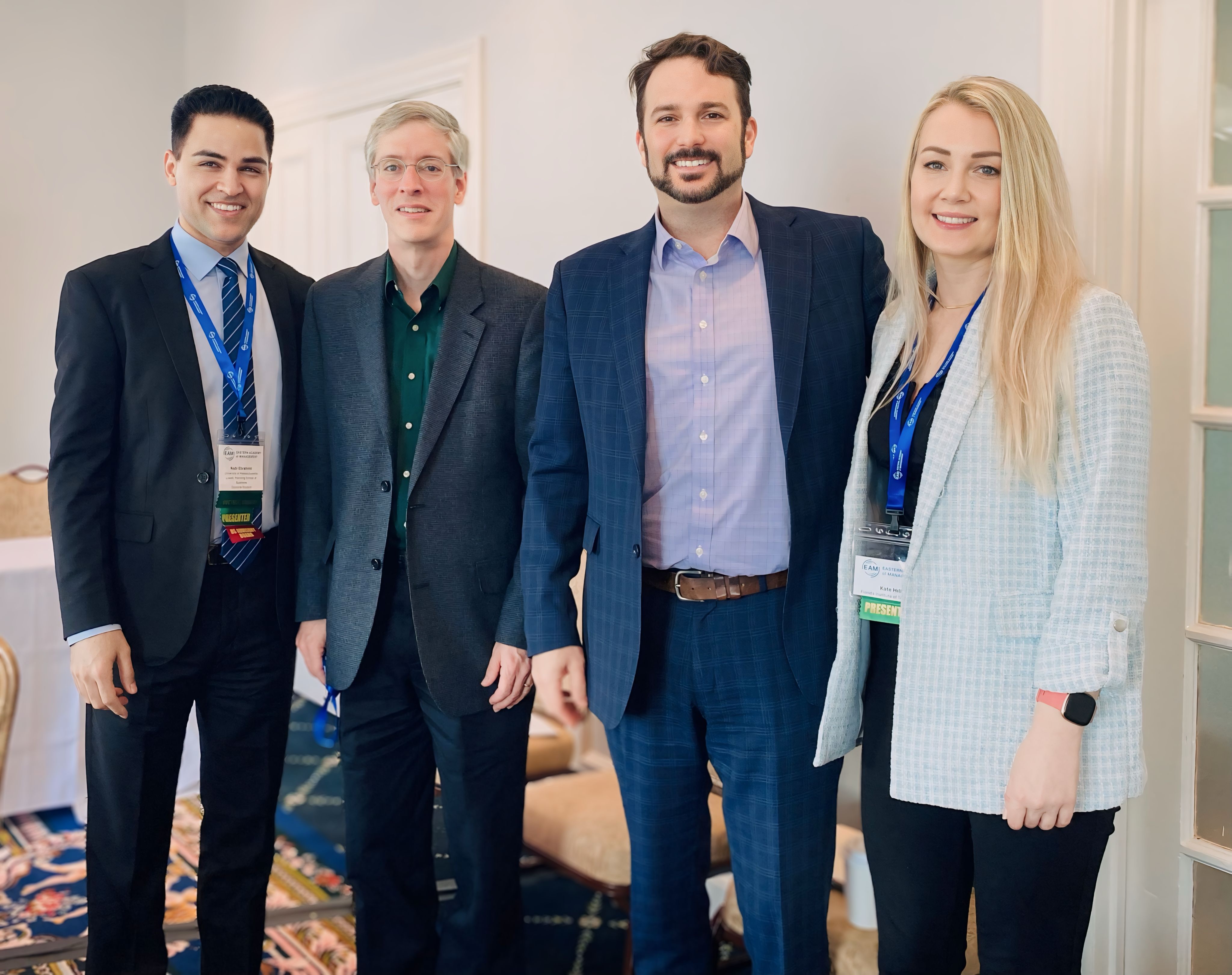
Ebrahimi, N., Montag-Smit, T. (2025). Employee felt trust: A critical review and future directions. Paper presented at the Eastern Academy of Management Conference, May 13-18, 2025, Baltimore, MD.
Ebrahimi, N., Montag-Smit, T. & Greenway D. (2024). Sustaining remote work: The role of movement flexibility and community embeddedness. Paper presented at the Academy of Management Conference, August 9-13, 2024, Chicago, IL.
Merriman, K., Ebrahimi, N., Kostanski, S. (2024). Nature at work: Unraveling the psychological valuation of biophilic work environments. Paper presented at the Academy of Management Conference, August 9-13, 2024, Chicago, IL.
Pirson, M., Ebrahimi, N., et al. (2024). Humanistic leadership and management- innovating for a humane future in a globalized world. PDW workshop presented at the Academy of Management Conference, August 9-13, 2024, Chicago, IL.
Ebrahimi, N., Montag-Smit, T. & Greenway D. (2024). Sustaining remote work: The role of movement flexibility and community embeddedness. Paper presented at the Eastern Academy of Management Conference, May 14-17, 2024, Providence, RI.
Ebrahimi, N., Montag-Smit, T., Kronrod, A. (2023). Effects of servant leadership on languishers’ social functioning and organizational identification. Paper presented at the Academy of Management Conference, August 4-8, 2023, Boston, MA.
Ebrahimi, N., Montag-Smit, T. (2023). Inclined to stay: When community embeddedness diminishes stress and enhances employee retention. Paper presented at the Eastern Academy of Management Conference, May 16 – 19, 2023, Philadelphia, PA.
Ebrahimi, N., Merriman, K., Montag-Smit, T. (2023). Servant leadership: A review of its mechanisms. Paper presented at the Eastern Academy of Management Conference, May 16 – 19, 2023, Philadelphia, PA.
Ebrahimi, N., (2016). The relationship between organizational efficacy and collective work engagement among Turkish employees. Paper presented at 3rd International Conference of Business Students. 13-14 May 2016, University of Sakarya, Turkey.
RESEARCH IN EDUCATION
Ebrahimi N. (2015). “Validation and application of the Constructivist Learning Environment Survey in English language teacher education classrooms in Iran.” Learning Environments Research, 18 (1), 69-93.
Ebrahimi N., Eskandari Z., Rahimi A., (2013). “The effects of using technology and the internet on some Iranian EFL students’ perceptions of their communication classroom environment.” Teaching English with Technology, 13(1), 3-19.
Ebrahimi N., Rahimi A., (2013). “Towards a more efficient EFL reading comprehension classroom environment: The role of content and critical reading.” Apples – Journal of Applied Language Studies, 7 (2), 1– 15.
Ebrahimi N., (2013). “Constructivist Translation Classroom Environment Survey (CTLES): development, validation and application.” Translation & Interpreting, 5 (2), 163-186.
Rahimi A., Ebrahimi N.A., (2011). “Constructivist vs. objectivist learning environments”. Contemporary Online Language Education Journal, 1, 89-103.
Goggle Scholar Page [Link]
 NabiEbrahimi.com